

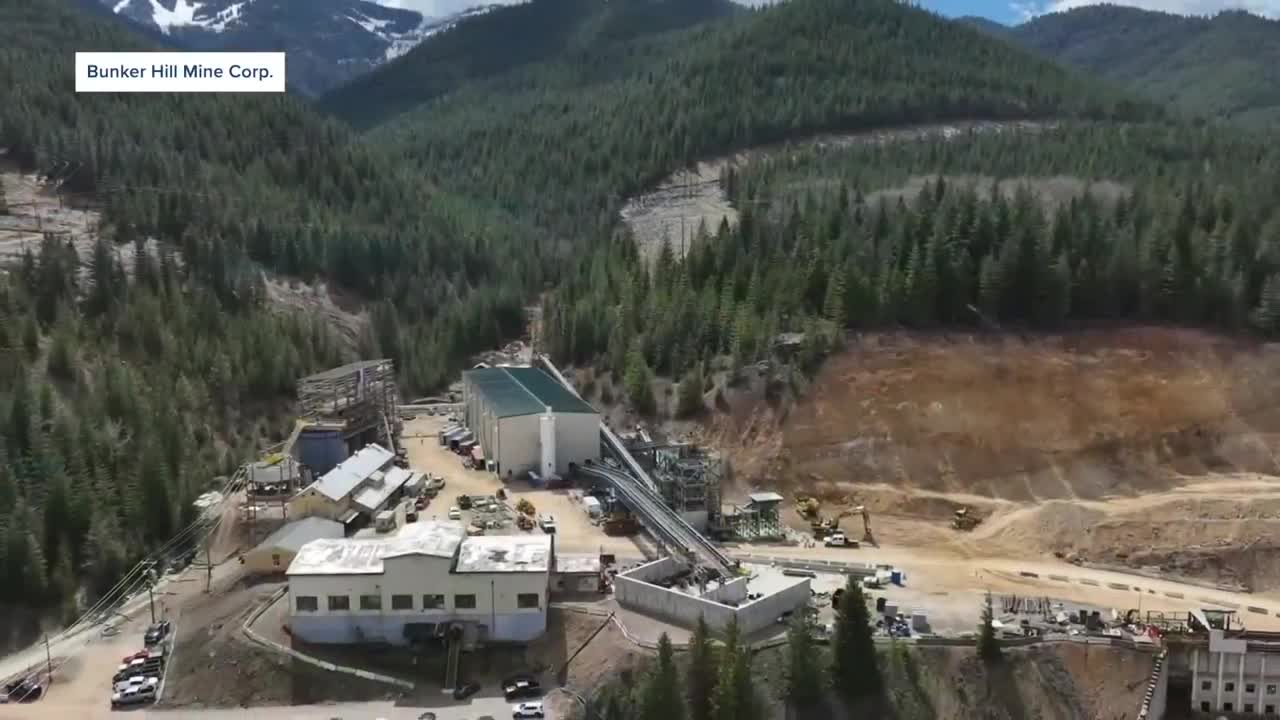


KELLOGG, Idaho — After decades of closure, the Bunker Hill Mine in Kellogg, Idaho, is working to ramp up operations, with commercial production targeted by the end of 2026.
WATCH: Bunker Hill Mine starts operations again after 40 years
The project has been in progress for six years. The company produced its first concentrate this summer as it continues working toward its production goals.
“We’re ramping up to commercial production, and we’ll achieve commercial production by the end of 2026,” Sam Ash, CEO of Bunker Hill Mining Corp., told me.
The mine is currently processing about 1,200 tons a day, with a goal of reaching 1,800 tons daily.
Sam Bourque, a geologist with Bunker Hill Mine, said advances in technology and processing have helped make it possible to pursue ore left behind when the mine closed.
“The addition of technology, metal prices, processing technology lets us go in and start mining that with full expectations of profitability and successful mining,” Bourque said.
RELATED | Valley Regional Transit celebrates 10 years of Main Street Station in Boise
The project is also part of a broader effort to expand mineral production in the United States as demand for domestically produced metals grows.
“We’ve got a lot of great diverse minerals in this state, a lot of critical minerals, and folks around the world are taking note of what’s going on in Idaho,” said Benjamin Davenport, executive vice president of the Idaho Mining Association.
The region has a long history of environmental damage from mining and smelting, according to the Environmental Protection Agency. Concerns around mining can include water quality, wildlife and long-term changes to the land.
Briana Halstead, director of permitting and planning at KC Harvey, discussed how environmental impacts are considered during project planning.
RELATED | Boise nonprofit opens emergency food pantry as more families it serves struggle to afford food
“A big concern often is the magnitude of those impacts as well as the permanency of those impacts,” Halstead told me.
She added that project design should take those issues into consideration and minimize impacts as much as possible.
Halstead also explained how the federal environmental review process can provide opportunities for public participation.
“Through the regulatory process, the NEPA process, it gives the public or other stakeholders a chance to weigh in, express their concerns, learn about the project,” she said.
Halstead said developers may need to change a project's design when valid concerns are raised during permitting.
RELATED | 'We will never forget': Rally highlights the Wilder raid on the Latino community nearly one year ago
For Bourque, the restart represents more than the production of metals. He said the mine has deep ties to families and generations of workers in the Silver Valley.
“To me, to be able to create another four generations of prosperity for the Silver Valley and see people show up to work … that makes me feel very good,” Bourque said.
Organizers expect mining to continue growing as efforts to bring critical-metal production back to the United States expand. Bunker Hill's next milestone is reaching commercial production, which the company is targeting by the end of 2026.
This story was initially reported by a journalist and has been, in part, converted to this platform with the assistance of AI. Our editorial team verifies all reporting on all platforms for fairness and accuracy.
