

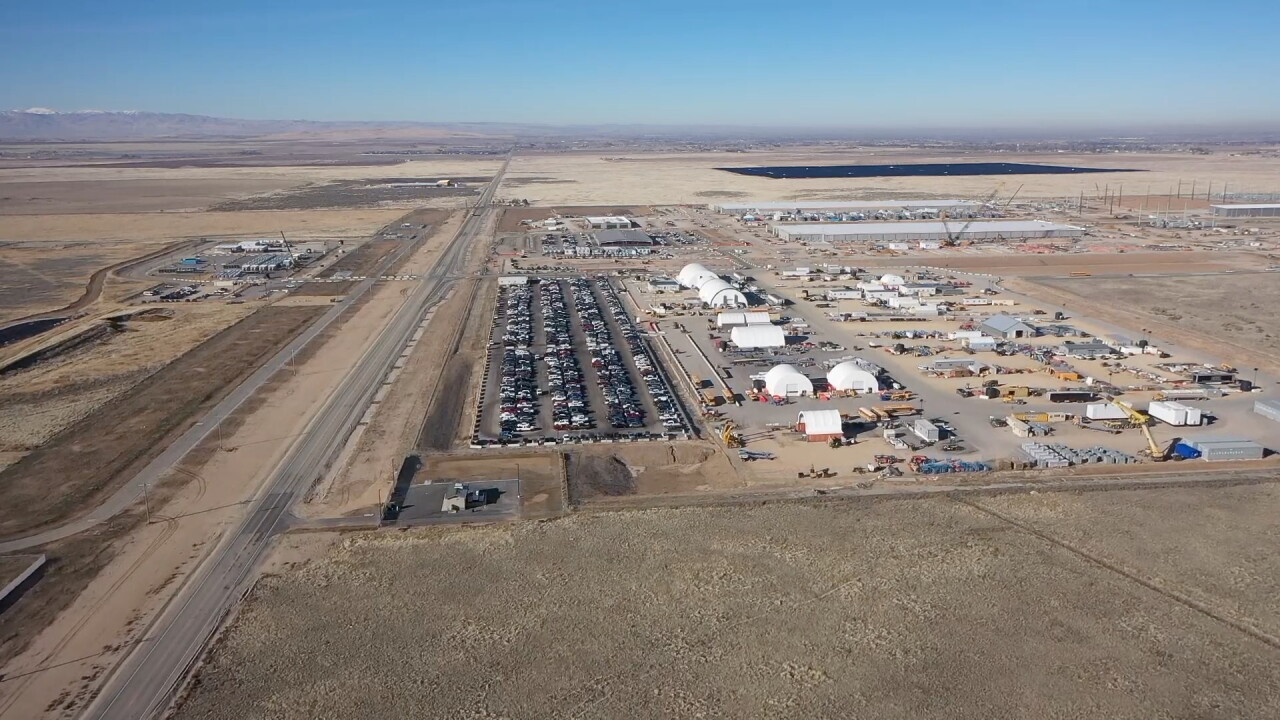


IDAHO — Data centers are expanding across the country, intensifying debate over the water and electricity required to operate them.
A new report from the Taxpayers Protection Alliance, a nonpartisan government watchdog group, argues those concerns have been overstated in Idaho. But as Bannock County prepares to study the issue, energy experts say current statewide usage may not show what much larger facilities could require in the future.
WATCH: Report challenges concerns about Idaho data center resource use as Bannock County studies potential impacts
“It’s twofold: opportunity and challenge,” said John Kumm, executive director of the University of Idaho Energy Institute.
Kumm said data centers can bring investment and new business to Idaho, which has historically offered relatively low electricity rates. However, the facilities being built today are becoming significantly larger.
“We’re seeing some that have electric power loads on the scale of a small town,” Kumm said.
The Taxpayers Protection Alliance, based in Washington, argues the industry’s effect on Idaho resources has been overstated.
Its report estimates data centers accounted for 0.01% of Idaho’s water consumption and 1.5% of its electricity use in 2025. Those figures estimate current statewide use, however, rather than the potential demand from large facilities still being planned or built.
RELATED | Idaho lawmaker aims to shield customers from rising power rates tied to data centers
“When the grid is, frankly, already constrained in some respects, then these large concentrated loads do make a difference,” Kumm explained. “They make a technical difference, they make a regulatory difference, and they can make a financial difference.”
Kumm also emphasized that data centers are not the only source of increasing electricity demand. Population growth, expanded manufacturing and broader electrification are collectively placing additional pressure on the power system.
In Bannock County, officials decided they needed more information before receiving a potential data center application.
The county has stopped accepting or processing data center applications in unincorporated areas for 180 days while officials develop the county’s first ordinance specifically governing the facilities. The moratorium does not apply within incorporated cities such as Pocatello.
“The big deal was we didn’t have an ordinance in place,” Bannock County Commission Chair Jeff Hough said. “And so we needed to do some studying to find out for ourselves what was applicable to Bannock County.”
Hough said a county study group will examine water use, noise, light, heat and potential economic effects. He stressed that the temporary moratorium is not a ban.
“Data centers can be a positive thing in your neighborhood, but it needs to be the right size and the right kind for your community and the resources that you have,” Hough said.
ALSO READ | Another data center is one step closer to being built in Kuna after rezoning approval
Water use can also vary significantly among projects, according to Kumm. Some cooling systems consume large amounts of water, while closed-loop systems recirculate and reuse most of it.
Kumm encouraged Idaho residents to evaluate claims made by both supporters and opponents of data center development.
“Have some skepticism about any answer that you get, whether you get that answer from a proponent or an opponent,” Kumm advised. “Have some skepticism, check your facts, and then make your conclusions.”
Bannock County’s moratorium remains in effect through Jan. 26, 2027. The county says its proposed ordinance will be available for public comment during the public hearing process.
